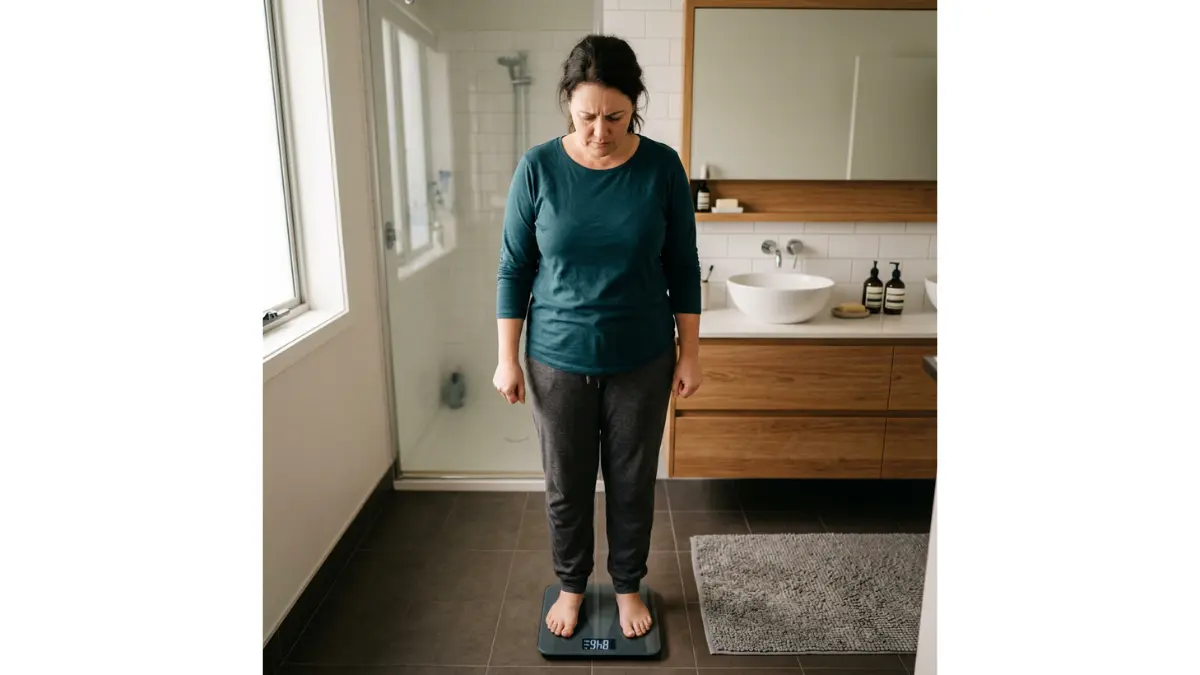
You are doing everything right. You cut your calories, you are eating cleaner than ever, and for a few weeks the scale was finally moving. Then, without warning, it stopped. Completely. This frustrating experience has a name: the weight loss plateau, and it is far more common than most people realize — especially in women over 40.
The hard truth is that eating less does not always mean losing more. There are several biological, hormonal, and metabolic mechanisms that can cause your body to simply stop responding to a caloric deficit — and understanding why this happens is the first step toward breaking through it.
In this article, you will learn exactly what causes a weight loss plateau, why it hits harder after 40, and what science-backed strategies — including targeted supplementation — can help you get the scale moving again.
What Is a Weight Loss Plateau and Why Does It Happen?
A weight loss plateau occurs when your body stops losing weight despite a maintained or reduced calorie intake. This is not a failure on your part. It is a survival response built into human biology.
When you consistently eat less, your body reads this as a potential threat to survival and adapts by slowing down your metabolic rate. This process is known as adaptive thermogenesis. The body essentially lowers the number of calories it burns at rest, making your original deficit less and less effective over time.
Research published in the American Journal of Clinical Nutrition confirms that adaptive thermogenesis can reduce resting metabolic rate by 10% to 15% beyond what is expected from weight loss alone. For many people, this adjustment happens within just a few weeks of dieting.
The Role of Hormones in Stalling Weight Loss
Hormones are perhaps the most underestimated factor in a weight loss plateau. Several key hormones shift dramatically when you reduce food intake or lose a significant amount of weight.
Leptin and Ghrelin Imbalance
Leptin is the hormone responsible for signaling fullness to your brain. When you lose body fat, leptin levels drop sharply, which reduces your metabolism and increases hunger. At the same time, ghrelin — the hunger hormone — rises, making you feel hungrier than before you even started dieting.
This hormonal combination creates a powerful biological pull toward eating more and moving less — the body fighting back against the weight loss plateau from multiple directions simultaneously.
Cortisol and Chronic Stress
Chronic caloric restriction is itself a stressor. Elevated cortisol — the stress hormone — promotes fat storage, particularly around the abdomen. Even if you are in a caloric deficit on paper, elevated cortisol can impair fat oxidation and contribute to a weight loss plateau that seems impossible to break.
Insulin Sensitivity and Blood Sugar Regulation
Poor insulin sensitivity means your cells do not respond efficiently to insulin, leading to excess glucose being stored as fat rather than used for energy. This is especially relevant for women in perimenopause and menopause, where hormonal shifts naturally reduce insulin sensitivity and can trigger or worsen a weight loss plateau.
Why Women Over 40 Are Especially Vulnerable to a Weight Loss Plateau
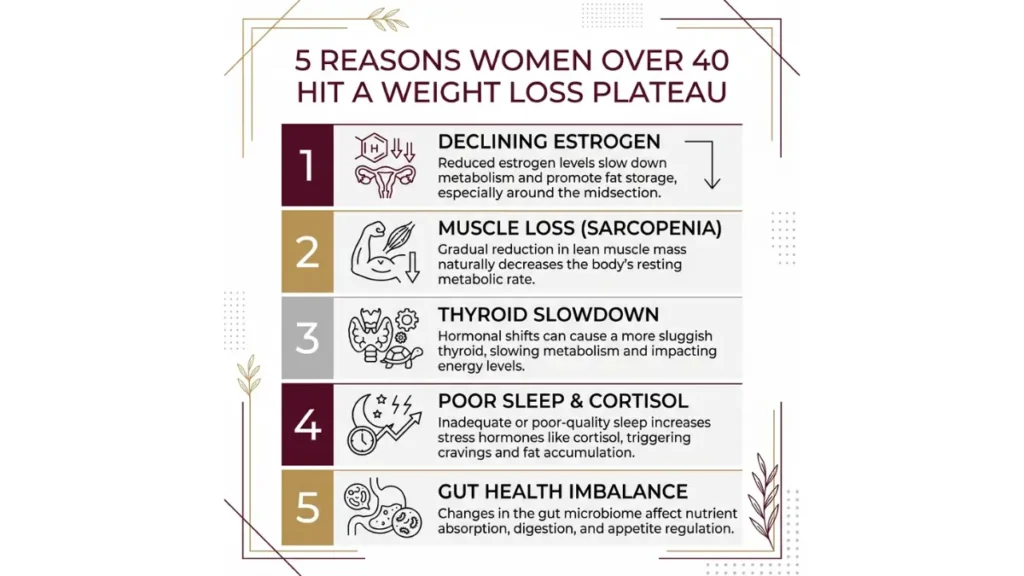
After the age of 40, the body undergoes a series of changes that make weight loss significantly more difficult — and plateaus more frequent and harder to break.
Here is what is happening physiologically:
- Declining estrogen levels reduce the body’s ability to burn fat efficiently and promote fat redistribution toward the abdomen.
- Loss of muscle mass (sarcopenia) accelerates naturally after 40, and since muscle tissue is metabolically active, less muscle means a lower resting metabolic rate.
- Thyroid function can slow with age, further reducing the number of calories burned at rest.
- Sleep quality tends to deteriorate, and poor sleep raises cortisol and ghrelin while lowering leptin — a perfect storm for a weight loss plateau.
- Gut microbiome diversity decreases, affecting how efficiently the body processes and absorbs nutrients.
The weight loss plateau, in this context, is not simply about willpower or discipline. It is a physiological reality that requires a strategic, multi-pronged approach.
Muscle Loss: The Silent Enemy of Your Metabolism
One of the most damaging — and least discussed — consequences of prolonged caloric restriction is muscle loss. When you eat too little, especially without adequate protein intake, your body begins breaking down muscle tissue for energy.
This creates a vicious cycle: the less muscle you have, the fewer calories you burn at rest. A lower resting metabolic rate means the same diet that once produced a deficit now barely maintains your weight. This is one of the primary physiological drivers behind a weight loss plateau in chronic dieters.
Strength training and adequate protein intake (typically 1.2 to 1.6 grams per kilogram of body weight) are essential strategies for preserving metabolic mass during a fat loss phase.

Calorie Creep and Unconscious Eating Patterns
Not every weight loss plateau is purely metabolic. Calorie creep — the gradual, often unconscious increase in food intake — is a common culprit. This can happen through slightly larger portion sizes, more frequent snacking, cooking oils not measured, or “healthy” foods consumed in excess.
Studies show that people consistently underestimate their caloric intake by 20% to 40%. Even without intentional cheating on a diet, daily variations in food measurement and preparation can easily add 200 to 400 calories per day — enough to erase a caloric deficit entirely and stall progress.
If you have been in a weight loss plateau for more than three to four weeks, a temporary return to precise food tracking for 7 to 10 days can reveal hidden calories you may not have noticed.
How Reduced Activity Levels Contribute to Stalled Results
When the body is in a caloric deficit, it does more than slow metabolism. It also instinctively reduces non-exercise activity thermogenesis (NEAT) — the calories burned through everyday movements like fidgeting, walking around the house, or standing rather than sitting.
Research from the Mayo Clinic suggests NEAT can account for 100 to 800 calories of variation per day between individuals. When NEAT drops involuntarily due to dieting, total daily energy expenditure falls — and your weight loss plateau deepens.
This is why structured exercise alone is often not enough. Increasing general movement throughout the day — walking more, taking stairs, standing during phone calls — can meaningfully counteract this metabolic adaptation.
Practical Strategies to Break Through a Weight Loss Plateau
There is no single solution that works for everyone, but the following strategies have strong scientific backing and are particularly relevant for women over 40 dealing with a weight loss plateau.
1. Reassess Your Caloric Target
As you lose weight, your maintenance calories decrease. A deficit calculated for your starting weight may no longer be a deficit at your current weight. Recalculating your total daily energy expenditure (TDEE) every 4 to 6 weeks helps ensure you stay in an active deficit.
2. Prioritize Protein and Resistance Training
Increasing protein intake supports muscle retention and has a higher thermic effect than carbohydrates or fats — meaning your body burns more calories just digesting it. Pairing higher protein intake with two to three sessions of resistance training per week is one of the most effective ways to restart fat loss after a weight loss plateau.
3. Implement a Structured Diet Break
A two-week diet break — eating at maintenance calories rather than a deficit — has been shown in research to partially restore leptin levels and metabolic rate, making subsequent dieting more effective. This is different from giving up; it is a strategic metabolic reset.
4. Prioritize Sleep and Stress Management
Seven to nine hours of quality sleep per night is not optional when you are trying to break through a weight loss plateau. Poor sleep directly impairs fat loss hormones. Stress reduction practices — whether meditation, gentle yoga, or time in nature — help manage cortisol levels that otherwise work against your goals.
5. Consider Targeted Supplementation
For women over 40 dealing with a stubborn weight loss plateau, certain supplements can provide additional metabolic support by addressing the hormonal and thermogenic mechanisms that make fat loss more difficult at this life stage.
Ingredients such as green tea extract (EGCG), chromium picolinate, berberine, and conjugated linoleic acid (CLA) have demonstrated the ability to support insulin sensitivity, enhance fat oxidation, and mildly increase thermogenesis without the cardiovascular risks associated with stimulant-heavy formulas.
A quality fat burner supplement formulated specifically for women over 40 can complement a well-structured diet and exercise plan — not replace them — by targeting the underlying biological factors that contribute to a weight loss plateau.

You might also enjoy reading this:
Ikaria Juice Supplement Review in 2026: Does This Weight Loss Formula Actually Work?
What Realistic Progress Looks Like After a Plateau
It is important to set accurate expectations. Breaking through a weight loss plateau does not mean the scale will suddenly drop rapidly again. Sustainable fat loss after implementing these strategies typically means losing between 0.5 and 1 pound per week — and that is a healthy, maintainable rate.
Some weeks the scale may not move at all, even as body composition improves. Water retention, muscle gain, and hormonal fluctuations all affect the number on the scale. Progress photos, waist measurements, and how your clothes fit are often more reliable indicators than weight alone.
Patience combined with consistency and strategic adjustment is what separates those who finally break through their weight loss plateau from those who give up just before progress resumes.
Final Thoughts: Your Plateau Is Not the End of the Road
A weight loss plateau is one of the most demoralizing experiences on a fat loss journey, but it is also one of the most universal. Understanding that it is driven by biology — not a lack of willpower — is both empowering and actionable.
If you are eating less and still not losing weight, the answer is not to eat even less. The answer is to work smarter: reassess your deficit, protect your muscle mass, address your hormones, sleep better, and consider whether targeted support from a high-quality fat burner supplement designed for women over 40 could be the missing piece.
Your body is not broken. It is adapting. And with the right strategy, you can adapt right back.

You might also enjoy reading this:
Ikaria Juice Supplement Review in 2026: Does This Weight Loss Formula Actually Work?
Frequently Asked Questions
Why am I in a weight loss plateau even though I am eating less than before?
When you consistently eat less, your body adapts by lowering its metabolic rate — a process called adaptive thermogenesis. This means fewer calories are burned at rest, which can cancel out your caloric deficit and stall weight loss. Hormonal shifts, reduced muscle mass, and unconscious decreases in daily movement also contribute to the weight loss plateau.
How long does a typical weight loss plateau last?
Without strategic intervention, a weight loss plateau can last anywhere from a few weeks to several months. Making adjustments to your caloric intake, increasing protein, adding resistance training, or implementing a brief diet break can help break the plateau significantly sooner.
Is a weight loss plateau more common after 40?
Yes. Women over 40 are particularly susceptible to a weight loss plateau due to declining estrogen, natural muscle loss, reduced thyroid function, and worsening insulin sensitivity. These hormonal and physiological changes make the body more resistant to fat loss and more prone to prolonged plateaus.
Can a fat burner supplement help break a weight loss plateau?
A well-formulated fat burner supplement can support the biological mechanisms behind a weight loss plateau — such as improving insulin sensitivity, gently increasing thermogenesis, and supporting fat oxidation. However, supplements work best as part of a comprehensive strategy that includes proper nutrition, adequate protein, resistance training, and quality sleep. They are a complement to good habits, not a replacement.

Marcus spent years working at the intersection of data analysis and consumer research before entering the wellness space. His professional background — spanning analytical roles in product evaluation and market research