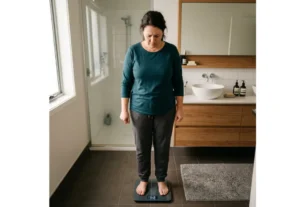

If you have hit your forties and noticed that the jeans fit differently even though you haven’t changed what you eat, you are not imagining things. You are also not alone. There is this moment that creeps up on most of us somewhere between the late thirties and early forties where your body starts responding differently to the same habits that kept you in shape for decades.
Maybe you used to drop five pounds just by cutting out soda for a couple weeks. Maybe you could eat pasta at dinner and wake up lighter. And now? Now it feels like the scale does not budge no matter what you try. You train harder. You eat cleaner. Your body seems to be holding on to everything.
There is a biological reason for that. It is not about willpower. It is not about age being an excuse. It is about real, measurable changes happening inside your body. And the good news is those changes are not permanent. You can fix your metabolism after 40. But you need to know what you are actually dealing with first.
This article breaks down exactly why your metabolism shifts after 40 and, more importantly, what you can do about it starting today.
What Is Really Happening to Your Metabolism After 40
Let’s clear something up right away. For years, the common belief was that your metabolism inevitably tanks the moment you hit 40. Recent research published in Science actually challenged that. The study found that metabolism stays fairly stable between ages 20 and 60. On paper, that sounds reassuring. But here is the catch.
That research measured total energy expenditure. It looked at how many calories people burn in a day, from breathing to walking to digesting. And yes, that number holds relatively steady during adulthood. But what changes dramatically is body composition. And body composition is the main driver of metabolic rate.
After 40, most people start losing muscle mass. This process is called sarcopenia, and it begins earlier than most people realize. Muscle is metabolically active tissue. It burns calories just by existing. Fat tissue, by comparison, burns very few calories. So when you lose muscle and gain fat, which is exactly what happens if you do not actively intervene, your resting metabolic rate drops. You burn fewer calories at rest than you used to. That is why the same diet that worked at 30 stops working at 45.
Hormones also play a huge role. Testosterone starts declining in men around age 30, roughly 1 percent per year. For women, menopause brings a sharp drop in estrogen, which changes how the body stores fat and uses energy. Cortisol, the stress hormone, tends to creep up with the responsibilities of midlife. And cortisol encourages fat storage, especially around the midsection.
Your mitochondria, the tiny power plants inside your cells, also become less efficient as you age. They produce less energy from the same amount of fuel. That means your body has to work harder to do the same things.
So, no, your metabolism does not fall off a cliff on your fortieth birthday. But the conditions that determine how fast or slow your metabolism runs shift significantly. And if you do not adjust, it will feel like your metabolism slowed down. Because functionally, it has.
Why Most People Get This Wrong
The biggest mistake people make when they hit 40 and start gaining weight is doing what worked before. They eat less. They run more. They chase the same calorie deficit formula that worked in their twenties. And it backfires.
When you slash calories too aggressively, your body interprets that as a threat. It does not know you are trying to fit into old clothes. It thinks food is scarce. So it slows down your metabolism even further. It holds onto fat for energy. It breaks down muscle for fuel. And muscle loss is exactly what you are trying to avoid in the first place.
This is what experts call metabolic adaptation. And it is the reason so many people over 40 find themselves eating fewer and fewer calories while seeing fewer and fewer results.
The fix is not to eat less. The fix is to change your approach entirely.
You might also enjoy reading this:
Key Strategies to Fix Your Metabolism After 40
Prioritize Protein at Every Meal

Protein is the single most important nutrient for metabolic health after 40. It has the highest thermic effect of food, meaning your body burns more calories digesting protein than it does digesting carbs or fat. But more importantly, protein is what fuels muscle maintenance and repair.
If you are not eating enough protein, your body will pull amino acids from your own muscle tissue. That accelerates the muscle loss that slows your metabolism. Aim for at least 30 grams of protein per meal. That looks like four eggs, a scoop of whey with milk, or a solid palm-sized portion of chicken or fish.
Lift Weights. Not Just Cardio.

If you only do one thing differently after reading this article, let it be this. Cardio is great for your heart and your mental health. But it does not build muscle. And muscle is what keeps your metabolism running.
Strength training triggers muscle protein synthesis. It signals your body to hold onto muscle and even build new muscle, which raises your resting metabolic rate. You do not need to become a bodybuilder. Two to three sessions per week of compound lifts, squats, deadlifts, rows, presses, is enough to create a measurable difference.
For women, especially those navigating perimenopause, strength training is even more critical. Estrogen loss accelerates muscle breakdown. Resistance training is the single most effective countermeasure.
Stop Starving Yourself
As counterintuitive as it sounds, eating more can sometimes help you burn more. Not more junk food. But more total calories from quality sources. Crash diets lower your metabolic rate by as much as 15 to 20 percent. When you reintroduce normal eating, the weight comes back quickly because your metabolism has not recovered.
Instead of extreme restriction, focus on eating enough to support your activity level. Most people over 40 do well with a modest calorie deficit of 300 to 500 calories below maintenance. Not 1,000. Not intermittent fasting seven days a week. Moderate, consistent, sustainable.
Fix Your Sleep

Sleep is probably the most underrated metabolic lever. When you are sleep-deprived, your body produces more ghrelin, the hunger hormone, and less leptin, the hormone that signals fullness. You also produce more cortisol, which encourages fat storage. And your insulin sensitivity drops, meaning your body handles carbohydrates less effectively.
If you are sleeping less than seven hours a night and wondering why your metabolism feels sluggish, start there. No supplement or workout plan can outrun bad sleep.
Manage Your Stress
This one is tough because telling someone to stress less feels dismissive. But the physiology is real. Chronic stress elevates cortisol. Cortisol encourages visceral fat storage, the dangerous fat around your organs. And high cortisol also breaks down muscle tissue.
You do not need to meditate for an hour a day. But finding ten minutes to step away, breathe, go for a walk, or do something that shifts your nervous system from fight-or-flight to rest-and-digest makes a real difference over time.
Realistic Results and Expectations
Here is the honest truth. If you are looking for a quick fix that will make you look twenty again in two weeks, this is not that. Fixing your metabolism after 40 is a gradual process. It takes consistency, not intensity. Most people who implement these strategies see noticeable changes within four to eight weeks. Not dramatic weight loss. But better energy, better body composition, and a slow, steady downward trend on the scale.
Some people lose five pounds in the first month. Others see very little movement on the scale but notice their clothes fit better because they are replacing fat with denser muscle tissue. The scale is not always your friend here. How you feel, how your clothes fit, and how your energy holds up through the day are better markers.
Who This Approach Works For
This approach works best for people who are already reasonably healthy but feel like the rules changed after 40. If you eat fairly well, exercise a few times a week, but still feel stuck, these strategies are exactly what you need.
It also works well for people who have tried extreme diets in the past and found that the weight came right back. The focus here is not on restriction. It is on building metabolic capacity. That is a fundamentally different approach, and it works because it is sustainable.
Who Should Be Careful
If you have a diagnosed medical condition, especially thyroid disorders, diabetes, or hormonal imbalances, you should work with a doctor before making major changes to your diet or exercise routine. The principles still apply. But the specifics may need to be adjusted based on your medications and your individual physiology.
Is This Approach Safe?
Yes. Every strategy outlined here is based on established nutritional science and clinical research. Protein intake at the levels recommended is safe for healthy adults. Strength training with proper form is one of the safest and most beneficial forms of exercise. Sleep optimization and stress management carry no risks.
The only risk is expecting instant results and quitting when they do not come. Patience matters more than perfection here.
Where to Start
You do not need to overhaul your entire life at once. Pick one thing. Add a serving of protein to breakfast. Schedule two strength workouts this week. Go to bed thirty minutes earlier. Commit to that one change for fourteen days. Then add another.
The people who fix their metabolism after 40 are not the ones who did everything perfectly. They are the ones who did a few things consistently over a long enough period of time to see the compound effect.
Final Verdict
Your metabolism after 40 is not broken. It has just adjusted to a new set of circumstances. Less muscle. Changing hormones. More stress. Worse sleep. The fix is not complicated, but it requires a mindset shift. You cannot out-hustle biology. You have to work with it.
Prioritize protein. Lift weights. Eat enough. Sleep well. Manage your stress. Do those five things consistently, and you will not just stop the metabolic slowdown. You will reverse it.
You might also enjoy reading this:
Frequently Asked Questions
Does metabolism really slow down after 40 or is it a myth?
Metabolism itself does not sharply decline at 40, but the factors that control it do change. Muscle mass decreases, hormones shift, and cellular efficiency drops. These changes make it feel like your metabolism slowed down, even if your baseline energy expenditure stays relatively stable until later in life.
What is the fastest way to boost metabolism after 40?
The fastest way to boost your metabolism after 40 is to increase muscle mass through strength training and increase your protein intake to support muscle repair. These two interventions have the most immediate and measurable impact on resting metabolic rate.
Can you reverse a slow metabolism after 40 without medication?
Yes. Most metabolic slowdowns after 40 are driven by lifestyle factors, not disease. Strength training, adequate protein, quality sleep, stress management, and avoiding extreme calorie restriction can reverse the trend without medication in most healthy adults.
How much protein do I need after 40 to keep my metabolism running?
Most people over 40 need between 1.6 and 2.2 grams of protein per kilogram of body weight per day. That is roughly 30 to 40 grams per meal for an average-sized person. This amount supports muscle maintenance and provides the highest thermic effect of any macronutrient.

Marcus spent years working at the intersection of data analysis and consumer research before entering the wellness space. His professional background — spanning analytical roles in product evaluation and market research